This is a term paper that I wrote for Patristics I, which I took this past spring semester through the Byzantine Catholic Seminary of Saints Cyril and Methodius. You can download the pdf version of it here:
The second-century Gnostic schools that St. Irenaeus of Lyon confronted in Against Heresies shared the conviction that the material creation is the defective work of an evil deity, and that salvation consists of human spirits escaping from their fallen bodies. St. Irenaeus answered this challenge with a central tenet of patristic theology: recapitulation (anakephalaiosis). In Christ’s Incarnation, God enters human history and takes up the whole of human nature in order to redeem creation from within. This paper examines St. Irenaeus’ doctrine of recapitulation as developed across Books III through V of Against Heresies, arguing that it vindicates the goodness of the body, affirms the redemption of creation, and establishes the Incarnation as the true grounding for the salvation of the flesh. The paper further contends that recapitulation constitutes a permanent theological resource against any anthropology that treats biological humanity as a deficiency to be overcome, rather than as a resource to be treasured. A concluding section identifies the structural return of Gnostic patterns in contemporary transhumanist, posthumanist, and artificial general intelligence/superintelligence eschatologies, which replicate the ancient contempt for the flesh by reimagining salvation as technologically enabled self-transcendence. St. Irenaeus’ vision, crowned in his declaration that “the glory of God is a living man; and the life of man consists in beholding God” (Gloria enim Dei vivens homo, vita autem hominis visio Dei), speaks directly to the present moment and offers us the true way to transcendence: theosis.
Introduction
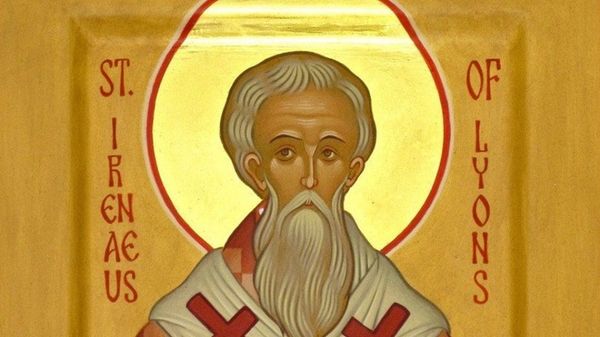
How does Christ save the flesh? St. Irenaeus of Lyon answered with a single word that became the key principle underlying his entire systematic theology: anakephalaiosis, recapitulation, the gathering up of all things under one head in the Incarnate Word. St. Irenaeus inherited from St. Polycarp the apostolic memory of St. John, and turned that memory against the most sophisticated theological adversary the early Church faced, the Gnostics. These schools of the second century taught that the material creation is the defective product of an inferior artificer, and that salvation consists of the soul’s escape from its bodily prison.
St. Irenaeus does not state recapitulation as a single thesis. He builds it across the last three books of Against Heresies. The argument of this paper follows St. Irenaeus’ own thought. Book III sets recapitulation as a Christological claim. Book IV grounds it in the goodness of the material creation. Book V brings it to its end in the salvation of the flesh. A closing section reads Ray Kurzweil’s transhumanist eschatology as a thematic return of the same failed anthropology St. Irenaeus refuted so long ago.
The Gnostic Challenge in Brief
What are the second-century heresies that St. Irenaeus confronts? The opening of Against Heresies surveys a family of false teachers whose systems differ in detail, but converge on a single failure of theological anthropology: the denial of the salvific destiny of creation.
St. Irenaeus’ archetype is Valentinus, whose elaborate myth of the Pleroma and the fallen Sophia lay behind a school still vigorous in his own day. Valentinians divided humanity into three natures, “spiritual, material, and animal, represented by Cain, Abel, and Seth,” of which only the spiritual was capable of perfection through gnosis, while the material went, “as a matter of course, into corruption.”1 Marcion taught that the divine Father of Jesus was wholly other than the Creator God found in Genesis, whose material handiwork was therefore alienated from the salvation offered by Christ.2 Basilides taught that “salvation belongs to the soul alone, for the body is by nature subject to corruption.”3 Carpocrates, in turn, taught that “the body is ‘the prison,’” from which souls escape only after passing by transmigration through every kind of embodied action.4
Modern secular historical scholarship has rightly grown wary of treating “Gnosticism” as a single position. David Brakke argues that Gnosticism is not really a single position, but instead refers to a diversity of esoteric schools that share certain mythic motifs but are irreducible to a unified system.5 Each of these groups, however differently they conceived of the nature of the cosmos, agreed that the body was either completely alien to the divine, merely accidental to salvation, or completely hostile to the good of the spirit. How does St. Irenaeus respond to these errors?
Book III: Recapitulation as Christological Claim
Book III proposes a response grounded in a single Greek noun: anakephalaiosis. The verb anakephalaioō means “to gather under one head” or “to sum up.” St. Paul uses the term in Ephesians 1:10 to name God’s purpose in Christ “to unite all things in him, things in heaven and things on earth.”6 This Pauline concept is the foundation of St. Irenaeus’ entire Christology—that the Word who created is the Word who became flesh, and that He became exactly what we are. The Word, he writes against the Gnostics who denied a real Incarnation, “was made what we were” in order to “recapitulat[e] in Himself His own handiwork.”7 John Behr has shown that recapitulation, for St. Irenaeus, is the integrating concept by which the entire economy of salvation holds together: the single thread on which Adam, Christ, the Church, and the eschaton are strung.8
Recapitulation requires the substantial unity of the Creator and the Redeemer. If the Father of Christ were not the Creator of this material world, then there would be no human body for the Word to gather up into Himself. Recapitulation would be impossible, because the human nature that the Word assumes would be utterly foreign to the God who saves it. Hence St. Irenaeus’ persistent return to the one Christ, the one Father, the one economy: “There is therefore, as I have pointed out, one God the Father, and one Christ Jesus, who came by means of the whole dispensational arrangements [connected with Him], and gathered together all things in Himself.”9 The Marcionite contrast between an evil Old Testament God against a good New Testament God collapses under this insistence, as does any other system that proposes the Incarnate Word to be of a different divine nature from the Creator of all things.
This same argument runs through the Adam-Christ, Eve-Mary pairings that St. Irenaeus so beautifully describes: “As by one man’s disobedience sin entered, and death obtained [a place] through sin; so also by the obedience of one man, righteousness having been introduced, shall cause life to fructify in those persons who in times past were dead.”10 St. Irenaeus extends the parallel through the Virgin in the same passage: as Adam was formed “from untilled and as yet virgin soil” by the Word, so the Word, “recapitulating Adam in Himself, rightly receive[d] a birth… from Mary, who was as yet a virgin.”11 Recapitulation gathers up not only the first man but the very conditions of his making. The Adam who fell is the same Adam who is taken up: “Wherefore Luke points out that the pedigree which traces the generation of our Lord back to Adam contains seventy-two generations, connecting the end with the beginning, and implying that it is He who has summed up in Himself all nations dispersed from Adam downwards.”12 God’s mercy in Eden, even His expulsion of Adam from the tree of life, was, for St. Irenaeus, the result of pity rather than of envy. Death itself was set “as a bound to his [state of] sin, by interposing death, and thus causing sin to cease… so that man, ceasing at length to live to sin, and dying to it, might begin to live to God.”13 In other words, the very act of dying belongs to the economy of recapitulation. Nothing in the human condition is wasted, not even the limits imposed by mortality.
Recapitulation, then, is the theological concept that encompasses God’s refusal to abandon the work of His own hands. The Father does not merely extract remnants of light from a defective cosmos. He gathers the whole of human history, including Adam himself, into the true man, Jesus Christ.
Book IV: Recapitulation and the Goodness of Creation
Book IV proves, by way of the Eucharist and the nature of the human person, that recapitulation entails the goodness of the material creation. If the Word recapitulates man, then the matter of which man is constituted, the wheat and the wine, the very dust of the earth, must itself be apt for redemption. The argument’s decisive move is liturgical, as St. Irenaeus shows that the Eucharist would be incoherent were a Gnostic anthropology true: “How can they say that the flesh, which is nourished with the body of the Lord and with His blood, goes to corruption, and does not partake of life?”14 The bread of the earth, when it is consecrated, “is no longer common bread, but the Eucharist, consisting of two realities, earthly and heavenly; so also our bodies, when they receive the Eucharist, are no longer corruptible, having the hope of the resurrection to eternity.”15 Creation and redemption hold together in the cup and the bread. The cup is “a part of the creation,” the bread “also a part of the creation,” and the same Word who established them establishes Himself in them. The economy of grace goes with the grain of the goodness of matter, not against it.
This is also exemplified by the legendary line at the climax of Book IV: Gloria enim Dei vivens homo, vita autem hominis visio Dei. “The glory of God is a living man; and the life of man consists in beholding God.”16 This sentence is often domesticated into the popular paraphrase “the glory of God is man fully alive,” which strips it both of its strict reference to the vivens homo, the living human person in his embodied integrity, and of the corresponding call to the visio Dei, the beatific vision in which that creature is fulfilled. St. Irenaeus is making a claim about the kind of being to whom God reveals Himself: the man of flesh and soul, capable of seeing God because he was made for that very seeing. The popular paraphrase mistakes the line for a maxim about human flourishing.
Book V: Recapitulation and the Salvation of the Flesh
Book V shows that recapitulation reaches its eschatological end in the salvation of the flesh. The book opens with the formula that Byzantine mystical theology has carried ever since: “The Word of God, our Lord Jesus Christ… did, through His transcendent love, become what we are, that He might bring us to be even what He is Himself.”17 This line marks the entrance of theosis, the patristic doctrine of deification, into history. To be deified is to attain salvation through the flesh. The spirit does not displace it; the spirit animates it. Theosis identifies what recapitulation accomplishes: the human person, gathered up through the obedience of the Word, is brought up into the very life of the Trinity without ceasing to be a creature.
Against this background, St. Irenaeus mounts his most direct refutation of the Gnostic position: “Vain in every respect, are they who despise the entire dispensation of God, and disallow the salvation of the flesh, and treat with contempt its regeneration, maintaining that it is not capable of incorruption.”18 If the flesh is not saved, then the Lord did not redeem us with His body and blood; the bread and wine cannot become His transfigured self for us to consume, “for blood can only come from veins and flesh, and whatsoever else makes up the substance of man, such as the Word of God was actually made.”19 If the flesh is not saved, then we cannot become one with God.
The Trinity creates “by the hands of the Father, that is, by the Son and the Holy Spirit, man, and not [merely] a part of man, was made in the likeness of God.”20 The two hands of God the Father lovingly shape the human creature into his two-fold composite of soul and flesh: “The perfect man consists in the commingling and the union of the soul receiving the spirit of the Father, and the admixture of that fleshly nature which was moulded after the image of God.”21 The flesh is not abolished in the eschaton. It is animated by the Holy Spirit and so inherits eternal life. The completed man is the whole creature whom the two hands have been guiding: a soul that has its flesh, a flesh that has its soul. M. C. Steenberg has argued that this is the structural shape of Irenaeus’ whole theology: to speak of God in Against Heresies is already to speak of the human creature, for the human creature is the theater in which God reveals what He is.22
The Contemporary Recurrence
Ray Kurzweil is the most articulate contemporary heir of ancient Gnostic patterns. Kurzweil has spent four decades arguing that human cognition will, by the middle of this century, transcend its biological substrate. Transhumanism names the project of using technology to surpass the present limits of human nature. Posthumanism names the condition that follows that surpassing. AGI (artificial general intelligence) and ASI (artificial superintelligence) name the technical milestones at which engineered minds match and then exceed unaugmented human cognition.23 Kurzweil’s The Singularity Is Nearer (2024) frames history in six “epochs,” at the sixth of which “our intelligence spreads throughout the universe, turning ordinary matter into computronium.”24 This is a complete eschatology. The Word does not become flesh; flesh becomes computation.
Echoes of Gnostic thought are everywhere throughout the book. Biology is a sign of our “frailty,” the body is “the enclosure of our skulls” from which the merged mind is “freed” into “a substrate millions of times faster than biological tissue.”25 On Kurzweil’s account, the body is not essential to the human person: in the 2040s and 2050s, “we will rebuild our bodies and brains to go vastly beyond what our biology is capable of,” so that “we will not be dependent on the survival of any of our bodies for our selves to survive.”26
The Gnostic heresies that St. Irenaeus refuted and overthrew are structurally present here. Human biology is treated as a deficiency to be overcome rather than as a substance to be redeemed. Where St. Irenaeus has transfiguration, Kurzweil has replacement. The Sixth Epoch is an eschaton without a resurrection. Jeffrey Pugh has documented this pattern in detail and given it a name: the para-Gnosticism of the transhumanist anthropology.27 Kurzweil is not a Valentinian. He has no demiurge, no divine spark, no metaphysical hatred of matter, in his cosmology. The pattern is “biology as obsolete and replaceable,” not “matter as evil.” Nonetheless, the despisal of human finitude is shared.
Conclusion
Recapitulation identifies the action by which the human person is saved in Christ. Theosis describes the Trinitarian dynamic into which the human person is saved. “The glory of God is a living man; and the life of man consists in beholding God.”28 The Word “did, through His transcendent love, become what we are, that He might bring us to be even what He is Himself.”29 Together, these two sentences answer both the ancient Gnostic and the contemporary transhumanist. Theosis is true transcendence, and the flesh that is glorified is the same flesh that was made. To be saved is to receive what the two hands have been forming since the beginning of creation.
Bibliography
Behr, John. Irenaeus of Lyons: Identifying Christianity. Christian Theology in Context. Oxford University Press, 2013.
Bostrom, Nick. Superintelligence: Paths, Dangers, Strategies. Oxford University Press, 2014.
Brakke, David. The Gnostics: Myth, Ritual, and Diversity in Early Christianity. Harvard University Press, 2010.
Irenaeus of Lyon. Against Heresies. Edited by Alexander Roberts and James Donaldson. Translated by Alexander Roberts and W. H. Rambaut. Ante-Nicene Fathers 1. Christian Literature Company, 1885.
Kurzweil, Ray. The Singularity Is Nearer: When We Merge with AI. Penguin, 2024.
Pugh, Jeffrey. “The Disappearing Human: Gnostic Dreams in a Transhumanist World.” Religions 8, no. 5 (2017): 81. https://doi.org/10.3390/rel8050081.
Steenberg, M. C. Of God and Man: Theology as Anthropology from Irenaeus to Athanasius. Bloomsbury Publishing, 2009.
- Irenaeus of Lyon, Against Heresies, bk. I.7.5.↩︎
- Irenaeus of Lyon, Against Heresies, bk. I.27.2.↩︎
- Irenaeus of Lyon, Against Heresies, bk. I.24.5.↩︎
- Irenaeus of Lyon, Against Heresies, bk. I.25.4.↩︎
- David Brakke, The Gnostics: Myth, Ritual, and Diversity in Early Christianity (Harvard University Press, 2010), 1–28.↩︎
- Eph. 1:10 (Revised Standard Version, Second Catholic Edition). All subsequent Scripture citations follow this version.↩︎
- Irenaeus of Lyon, Against Heresies, bk. III.22.1↩︎
- John Behr, Irenaeus of Lyons: Identifying Christianity, Christian Theology in Context (Oxford University Press, 2013), 144–62.↩︎
- Irenaeus of Lyon, Against Heresies, bk. III.16.6.↩︎
- Irenaeus of Lyon, Against Heresies, bk. III.21.10.↩︎
- Irenaeus of Lyon, Against Heresies, bk. III.21.10.↩︎
- Irenaeus of Lyon, Against Heresies, bk. III.22.3.↩︎
- Irenaeus of Lyon, Against Heresies, bk. III.23.6.↩︎
- Irenaeus of Lyon, Against Heresies, bk. IV.18.5.↩︎
- Irenaeus of Lyon, Against Heresies, bk. IV.18.5.↩︎
- Irenaeus of Lyon, Against Heresies, bk. IV.20.7.↩︎
- Irenaeus of Lyon, Against Heresies, bk. V preface.↩︎
- Irenaeus of Lyon, Against Heresies, bk. V.2.2.↩︎
- Irenaeus of Lyon, Against Heresies, bk. V.2.2.↩︎
- Irenaeus of Lyon, Against Heresies, bk. V.6.1.↩︎
- Irenaeus of Lyon, Against Heresies, bk. V.6.1.↩︎
- M. C. Steenberg, Of God and Man: Theology as Anthropology from Irenaeus to Athanasius (Bloomsbury Publishing, 2009), 16–54.↩︎
- Nick Bostrom, Superintelligence: Paths, Dangers, Strategies (Oxford University Press, 2014), 22–29.↩︎
- Ray Kurzweil, The Singularity Is Nearer: When We Merge with AI (Penguin, 2024), chap. 1.↩︎
- Kurzweil, The Singularity Is Nearer, chap. 2.↩︎
- Kurzweil, The Singularity Is Nearer, chap. 6.↩︎
- Jeffrey Pugh, “The Disappearing Human: Gnostic Dreams in a Transhumanist World,” Religions 8, no. 5 (2017): 81, https://doi.org/10.3390/rel8050081.↩︎
- Irenaeus of Lyon, Against Heresies, bk. IV.20.7.↩︎
- Irenaeus of Lyon, Against Heresies, bk. V preface.↩︎